


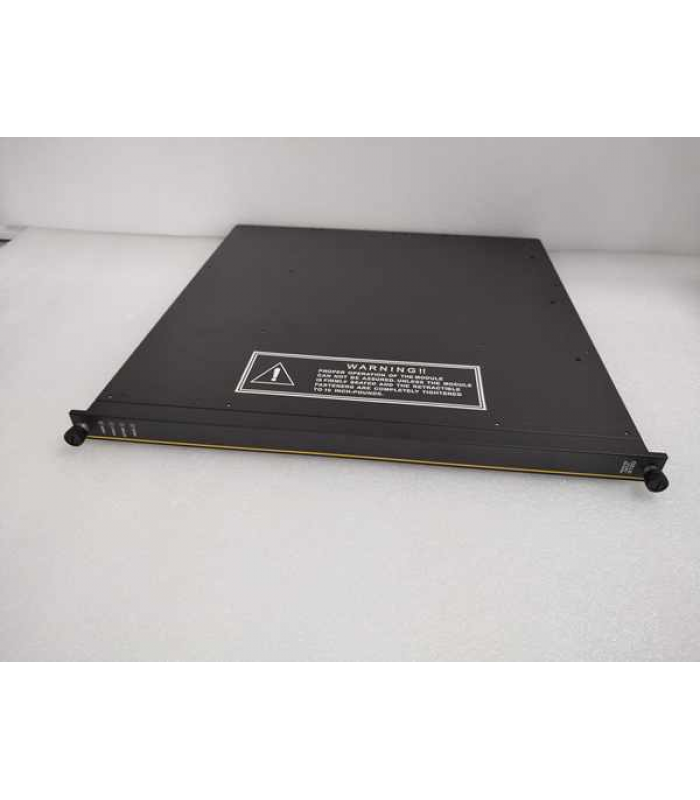
Triconex 3720 Safety Instrumented System Controller
- Product Code: 3720
- Availability: In Stock
Triconex 3720
Safety Instrumented System Controller
Overview
The Triconex 3720 is a high-performance safety controller from Schneider Electric's Triconex family of Safety Instrumented Systems (SIS). Designed for critical industrial applications, the 3720 controller employs Triple Modular Redundancy (TMR) architecture to provide unparalleled reliability and fault tolerance in safety-critical environments.
As part of the Triconex 3700 series, the 3720 controller is specifically engineered to meet the most demanding safety requirements across various industries. It delivers continuous, fail-safe operation even in the event of multiple component failures, ensuring maximum protection for personnel, equipment, and the environment.
Key Benefits
- ✓ Proven TMR technology with over one billion safe operating hours
- ✓ SIL 3 certification for highest safety integrity
- ✓ Continuous operation even during multiple component failures
- ✓ High availability with fault tolerance design
- ✓ Flexible configuration for diverse industrial applications
Technical Specifications
General Specifications
| Model | Triconex 3720 |
| Architecture | Triple Modular Redundancy (TMR) |
| Safety Certification | SIL 3 (IEC 61508) |
| Safety Integrity Level | SIL 3 |
| MTBF | >100,000 hours |
Electrical Specifications
| Power Supply | 24 VDC (redundant) |
| Input Voltage Range | 18-32 VDC |
| Power Consumption | <10 W (typical) |
| Isolation | High-voltage isolation for noise immunity |
Performance Specifications
| Processing Speed | High-performance processors |
| Response Time | <10 ms (typical for safety functions) |
| I/O Capacity | Scalable up to 512 I/O points |
| Control Loops | Up to 128 control loops |
| Voting Logic | 2-out-of-3 voting for fault tolerance |
Environmental Specifications
| Operating Temperature | -40°C to +70°C |
| Storage Temperature | -40°C to +85°C |
| Relative Humidity | 5-95% non-condensing |
| Vibration Resistance | 10-2000 Hz, 10 g peak |
| Shock Resistance | 50 g, 11 ms duration |
Architecture and Design
Triple Modular Redundancy
The Triconex 3720 employs Triple Modular Redundancy (TMR) architecture, which consists of three identical and independent processing channels that operate simultaneously. Each channel processes the same inputs and executes the same control logic, providing a high level of fault tolerance.
- • Three independent processors operating in parallel
- • 2-out-of-3 voting logic for fault detection and isolation
- • Continuous operation even with one or two channel failures
- • Hot-swappable components for maintenance without shutdown
Hardware Components
| Main Processor Module | Triple redundant processors |
| Memory | Program and data memory with error detection |
| I/O Modules | Digital and analog I/O with TMR architecture |
| Communication Modules | Redundant communication interfaces |
| Power Supplies | Redundant, fault-tolerant power supplies |
Functional Capabilities
Safety Functions
- • Emergency Shutdown (ESD)
- • Fire and Gas Detection System Integration
- • High Integrity Pressure Protection System (HIPPS)
- • Burner Management Systems
- • Boiler Protection Systems
- • Turbine Control and Protection
Programming Capabilities
- • Triconex TriStation 1131 programming environment
- • IEC 61131-3 standard programming languages
- • Function Block Diagram (FBD)
- • Ladder Diagram (LD)
- • Structured Text (ST)
- • Sequential Function Chart (SFC)
Communication Features
- • Redundant Ethernet interfaces
- • Modbus TCP/IP
- • Ethernet/IP
- • PROFIBUS DP
- • OPC UA
- • Serial communication (RS-232, RS-485)
Diagnostic Features
- • Comprehensive self-diagnostics
- • Real-time fault detection and isolation
- • Online module health monitoring
- • Historical event logging
- • Advanced Diagnostic Expert (ADE) software
- • Remote monitoring and diagnostics
Safety Features
Advanced Safety Mechanisms
Fault Tolerance
TMR architecture ensures system operation continues even with multiple component failures, preventing spurious trips and maintaining safety.
Voting Logic
2-out-of-3 voting on all inputs, outputs, and internal calculations ensures that single-point failures cannot cause dangerous failures or spurious trips.
Fail-Safe Design
Designed to fail in a safe state, ensuring that in the event of a critical failure, the system transitions to a predefined safe condition.
Watchdog Timers
Multiple independent watchdog timers monitor processor operation and can trigger safe shutdown if processing anomalies are detected.
Memory Protection
Error detection and correction codes (EDAC) protect against memory errors, ensuring program integrity and data reliability.
Online Testing
Comprehensive online diagnostics and testing capabilities allow for continuous verification of system integrity without process interruption.
Applications
Typical Applications
- → Emergency Shutdown Systems (ESD): Protecting personnel, equipment, and the environment by initiating controlled shutdowns when hazardous conditions are detected
- → Fire and Gas Detection Systems: Monitoring for fire, smoke, and toxic or combustible gas presence to trigger appropriate safety responses
- → High Integrity Pressure Protection Systems (HIPPS): Preventing overpressure in pipelines and equipment to avoid catastrophic failures
- → Burner Management Systems: Ensuring safe startup, operation, and shutdown of fired equipment
- → Turbine Control and Protection: Monitoring and controlling turbine operations to prevent damage and ensure safe operation
Industry Sectors
- → Oil and Gas: Upstream, midstream, and downstream applications including offshore platforms, refineries, and pipelines
- → Chemical Processing: Protecting chemical manufacturing processes, reactors, and storage facilities
- → Power Generation: Fossil fuel, nuclear, and renewable power plants for boiler protection and turbine control
- → Pharmaceutical: Ensuring product quality and safety in pharmaceutical manufacturing processes
- → Pulp and Paper: Protecting critical equipment and processes in paper manufacturing
- → Food and Beverage: Maintaining safety and quality in food processing operations
System Integration
Integration Capabilities
- • Seamless integration with DCS systems
- • Integration with HMI/SCADA systems
- • Connection to field instruments and sensors
- • Integration with asset management systems
- • Safety system network integration
Software Tools
- • TriStation 1131 for system configuration and programming
- • Triconex Safety File Configuration Manager
- • Triconex Digital Engineering Console
- • Triconex TriStation 1131 Emulator
- • Enhanced Diagnostic Expert (ADE)
- • EcoStruxure System Advisor - Process Safety
Maintenance and Service
Maintenance Recommendations
- ✓ Regular Inspection: Periodically inspect the system for signs of damage, overheating, or contamination
- ✓ Functional Testing: Perform regular functional tests to verify system integrity
- ✓ Firmware Updates: Keep firmware updated to the latest version for optimal performance and security
- ✓ Backup Configuration: Regularly backup system configuration and program files
- ✓ Component Replacement: Replace components as recommended by the manufacturer or when diagnostics indicate degradation
- ✓ Professional Service: Engage qualified personnel for complex maintenance and repairs
Testing and Validation
Regular testing and validation are critical to ensuring the Triconex 3720 continues to meet safety requirements. Testing should include:
- Periodic partial stroke testing of final elements
- Logic solver diagnostics and self-tests
- Input device testing and calibration
- Communication network integrity checks
- Full function testing during planned shutdowns
Certifications and Compliance
Safety Certifications
- IEC 61508 (SIL 3)
- ISO 13849-1 (PLe)
- IEC 61511
- TÜV Rheinland Certified
Hazardous Area
- ATEX
- IECEx
- Class I, Div 2
- Zone 2
Environmental
- RoHS Compliant
- REACH Compliant
- WEEE Compliant
Quality
- ISO 9001 Certified
- ISO 14001 Certified
- ISO 45001 Certified
Triconex 3720 Safety Controller
A proven solution for safety-critical industrial applications
Part Number: 3720
Manufacturer: Schneider Electric (Triconex)